Kollam fest 2011 is an international event focusing art, culture, trade and tourism organized by the Kollam Corporation, which is scheduled to commence on 1st November.
Kollam Fest is destined to be the signature event in Kollam for year 2011 as well as the years to come. Kollam Fest aims to showcase our rich Culture & Heritage, Tourism potential, Investments for the new ventures, et al through the month long gala event. The fest aims to constitute an award in the name of the late renowned actor O.Madhavan for the best professional theatre group in Kerala.
Vayala Vasudevan Pillai Theatre Fest
 A theatre festival to commemorate late Vayala Vasudevan Pillai is an important event in the fest.
Kollam is the abode of the largest number of mainstream theatre groups of Kerala; Kollam District hosted the first workshop on theatre was initiated by G Sankara Pillai that heralded the arrival of the modern theatre in Kerala, and Kollam the birthplace of eminent playwrights Pulimana Parameswaran Pillai, CN Sreekantan Nair, Kadavoor G Chandran Pillai, O Madhavan and Vayala Vasudevan Pillai. Thus this city should be a natural arena where meaningful theatre has to occur. The different plays featuring in this fest is aimed for the same.
The Vayala fest is inaugurated by the veteran actor from Tamil nadu Y G Mahendra and his play titled Venka 3 written by Chithralayam Shreeram, directed by YG Mahendra, and performed by UAA Chennai marked the opening of the fest on the eve of 21 11 2011.
The other plays and their schedule in the fest are
Melvilasam Directed by Soorya Krishnamurthy; performed by Soorya Theatre Group Thiruvananthapuram- 27/11/11 7.00 pm
 Adapted from a Hindi play "Court Martial' by Swadesh Deepak and inspired from the experiences of Gopi Poojapura, an ex-soldier of Indian Army and mentor of Soorya Krishnamoorthy, the play highlights the caste differences in the Society. The trauma experienced by a jawan from a backward community, who is ill treated by his superiors is brought out through an emotional presentation and effective dialogues. All the characters of the drama, in military uniforms enact an emotional scene of court martial proceedings. The play goes into the reasons that compelled the soldier to commit the murder of his officer and seeks to depict the relentless fight between the privileged and the downtrodden.
Dr Raja Warrior will commemorate Vayala Vasudevan Pillai before the play.
Lankalakshmi written by CN Sreekantan Nair, Directed by Chandradasan and performed by Lokadharmi, Kochi- 03/12/11 7.00 pm
 C. N. Sreekantan Nair's ‘Lankalakshmi' is a challenge for any director, for its text featuring poetic language and imagery. The production breaks the conventional approach to the text, design and acting and. The performance contextualises the play by sandwiching it between ‘Kamba Ramayanam' and Ezhuthachan's ‘Adhyatma Ramayanam.' While the Kamba Ramayanam handles the myth in a humorous manner, with no touch of piety at all, Ezhuthachan's ‘Ramayanam' was a creation of the Bhakthi movement. C.N.'s ‘Ramayana' is somewhere in between.
Chandradasan will commemorate CN Sreekantan Nair before the play.
Makkalkoottam, written by Suresh Babu Sreestha, directed by Pramod Payyannur, performed by Prakash Kalakendram Neeravil, Kollam- 05/12/11 7.00 pm
 Makkalkoottam, directed by Pramod Payyannoor is based on a novel by TV Kochubava, and presented by Prakash Kalakendram, Neeravil, Kollam, won the second best actor awards for Rajesh Sharma and Sreeranjini. This play looks into the untouchable community of low caste Chakkilayan, who have been marginalised into the outskirts of the society; victims of social custom, ignorance, and exploited by the upper caste/class. The play uses a narrative style mixing up of traditional narrative of Theyyam, and Tholpavakoothu, along with realism. Innovative space design with good technical execution is the hall mark of the play.
The day’s commemoration talk is on Kadavoor G Chandran Pillai and will be done by Prof. Biyatrees Alex.
Spinal Cord, written and directed by Deepan Sivaraman, and performed by Oxygen theatre company Thrissur - 06/12/11; 7.00 pm
 Spinal Cord narrates the story of a murder and its tragic consequences in a township. Twenty seven years after the incident the victim’s mother wakes up from a haunting nightmare with unpleasant memories of her son. Through the faded memories of the 80 year old mother, we start to know the tragic story of her son and the entire consequences of that honour killing. The play develops through the narration of the mother which often oscillates between past and present. When the newlywed Angela and Kunjavaran retire to their wedding night, Kunjavaran discovers that his wife is not a virgin. Shocked and angry, he returns Angela to her family home that very night, where her humiliated brother beats her savagely and demands to know her violator and she names Nasar. Nasar is unaware of the allegations that have been cast against him. But with Angela’s brother bent on avenging their family honour, the whole town is abuzz. They all know whom he plans to kill, where and when.
P Balachandran will talk on Prof G Sankara Pillai at 6.30 pm
Kalamkariyude Katha, written by Sreeja Arangottukara, directed by Smitha M Babu, and performed by Prakash Kalakendram Vanithavedi, Neeravil, Kollam - 08/12/11 7.00 pm
Kalamkariyude Katha,’ vividly portrays the creative sensibilities and inner conflicts of a potter woman. It unveils a widow’s zest for life and her struggle to survive in a society that still ostracises widows in many ways. The turbulence that Kalamkari has to undergo in her life followed by her husband’s death and her struggle to keep her creativity alive by making pots form the central theme of the play. But through it, ‘Kalamkariyude Katha’ also throws light on the survival instincts of human beings in a poignant manner, and the play oscillates between fantasy and reality. The play, scripted by Sreeja K.V., had won the Kerala Sangeeta Nataka Akademi’s award for the second best script.
There will be a debate on women’s theatre at 6.30 pm
Lankalakshmi
“The plot of this play is not just the frailty of a king who is an admirer of beauty. War, diplomacy, ethnic conflicts, ups and downs of ethics, etc are engrossed in it… It originated from the blood that surged from the severed breast of Soorppanakha. That river of blood is ferociously flooding down, with all its fury. Betrayal, Deceit, Destruction, and Death have taken charge of the four destinations…. Now, there remains just a single resolution….”
This play is about the anxieties and agonies of war. It can be said that war is the protagonist and antagonist of this play, and is reflected in different shades in different characters, with Ravana as the key metaphor. Death is projected in all its intensity; the death of heroes is continuously taking place, one after the other. Amidst the continuity of deaths of dear and near ones, the play envisages the plight of Ravana caught in the cross-roads of life and death, the ultimate fate of an egoist reveling in his physical and mental prowess.
The play starts when Rama and his army has crossed the sea, reached Lanka and is waiting outside the fort of Ravana; the war is imminent and near. The first act of the play portrays the internal conflicts and turbulence in the Ravana clan at the face of the war; different voices rise within the race.
"All the treasures in the three worlds should belong to Lanka," is the motive force that leads Ravana. He went after women, not just because he fancied them, but also to enrich his pedigree, to glorify Lanka. In its wake might have come, lurking shadows of crime and curse. Sita is the priceless jewel that should be part of Lanka, even if she is married to another man.
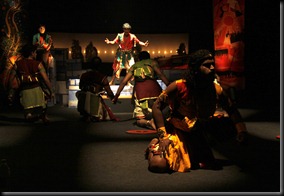 The conflict between Ravana and his brother Vibheeshana goes back to their childhood. His companionship with his uncle Suparsvan reveals the generosity of give and take, although decision-making is the prerogative of Ravana. The conversation between them is like an inner monologue. The love for his brother Kumbhakarna is another tender knot that breaks his heart. His pride in his son is a pointer to his shattered persona as he hears the death of Meghanadhan. His intimate bond with his wife Mandodari is another aspect of his noble nature. Soon the enemy enters his palace, ravishes Mandodari.
The play is designed to be an intimate experience to the audience where the acting area merges and diffuses into the audience area. The presence of Sita and Soorppanakha depicted with paintings. The throne, palace, and the mighty Himalayas, where Ravana travels are abstracted into a multilevel set painted by monotones of blue.
The music has sounds of rain, thunder, wind, birds, and animals to create the ambience of a war field surrounded by ferocious sea of blood.
The narrative of the play takes place in a three dimensional space with varying perspective. The three different narratives used simultaneously merges and juxtapose to create a more universal meaning to the whole rendering. The text written by CN Sreekantan Nair is sandwiched between the Recital of Adhyatma Ramayana written by Ezhuthachan which is based on Bhakthi and Ramayana by Kambar (rendered as Tholpavakoothu) which treats Ramayana down to earth and looks into the potentials of the text as a performance.
 The Artists Participating in the show at Kollam are VR Selvaraj, Sanosh Palluruthy, Johny Thottunkal , Ajaikumar Thiruvankulam , Madan Kolavil, Jolly Antony , Cijin Sukumar , Shaiju T Hamza , Joshua Antony K , Adithye KN, Muthumani Somasundaran , Kalamandalam Prabhakaran Jenson, Manosh, Kishore NK, Jebin Jesmes , Shirly Somasundaran K Viswanatha Pulavar & Group Koonathara, Shoranur , Pattanam Rasheed , Prasanth Madhav and Gireesh Menon.
This is the third performance of the play.
Labels: Chandradasan, CN Sreekantan Nair, Lankalakshmi, Lokadharmi, theatre


![lankalaksmi[3]](https://blogger.googleusercontent.com/img/b/R29vZ2xl/AVvXsEinFFNJ_xsYzEPGosaOXjU0XKUN2LI99X8rxt310HvVxl4JdQsnkqsT203zvjau0E-HDBUGLoFxCiNUJvENhNmA-FaWu0YXhzt4UXyuev_-PfxBitrJYN7yPB90khNu6z9oreYUB3hh3oIM/s1600-h/lankalaksmi%25255B3%25255D%25255B4%25255D.jpg "lankalaksmi[3]")


![38358_1558969538006_1348307920_1467695_1001785_n[1]](https://blogger.googleusercontent.com/img/b/R29vZ2xl/AVvXsEg1pWSS-uxtf6j3Rchxz0EJh0nN7FLpLVgF44PzuiGZ5mEGA6MnEqgsK80LsVBNQKNX6RA0T-3I00GpQkD3jFiaGeWr-qft6NzFyy2855X1I7lPvbMJnZNtxlDJKoaRqEzXUcJs3LfEpjF9/s1600-h/38358_1558969538006_1348307920_1467695_1001785_n%5B1%5D%5B3%5D.jpg "38358_1558969538006_1348307920_1467695_1001785_n[1]")