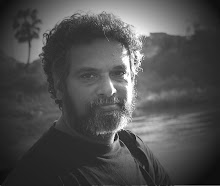
As usual, this year’s Soorya Theatre Festival is scheduled from October 11th to 20th with the performance of 14 plays by 13 directors. The festival takes place at Model School auditorium, Thiruvananthapuram at 6.45 pm. One of the highlights of this year’s festival is Avanavan Kadamba, the milestone production in the history of Malayalam theatre. Three plays that have won awards in the recently finished Amateur theatre festival of Kerala Sangeeta Nataka Akademi is included along with two plays directed by Soorya Krishnamurthy. A play in Tamil by YG Mahendran is another attraction. Bommanahalliyile Kinnara yogi written and directed by me for Mazhavillu, the children’s theatre of Lokadharmi is also included in this festival.
The festival showcases plays of directors like Kavalam Narayana Panikkar, Gopan Chidambaram, Sasidharan Naduvil, M.Vinod, K. Vinodkumar, PAM Rashed and Pramod Payyannur.
Parinayam (Marriage) – Soorya Krishnamoorthy- Soorya, Thiruvananthapuram (11th October)
‘Parinayam,' scripted by M.T. Vasudevan Nair and directed by Soorya Krishnamoorthy, relives the injustice of ‘smarthavicharam.'- a journey back in time; into the most infamous of the ‘smarthavicharams' – that of Kuriyedathu Thathri, that took place way back in July, 1905.

The play has references to ‘Adukkalayilninnum Arangathekku,' the path-breaking play written by V.T. Bhattathirippad and Lalithambika Antharjanam's work ‘Agnisakshi, used to transport us back to those unfortunate times when the social order was certainly skewed in terms of gender justice.
The woman who is under trial never appears on stage, and is known only by a voice, which speaks but little; reminiscent of the role forced on the Namboothiri women of the past. Yet, she does not leave the scene of the community court-martial as a desolate woman, but as one who promises to return with a vengeance, through Ammu, a woman born from her womb- the omnipresent contemporary element in all the works of Soorya Krishnamurthy.
Marmmaram (Murmur) – Soorya Krishnamoorthy- Soorya, Thiruvananthapuram (12th October)
 Marmmaram is written and directed by Soorya Krishnamoorthy is a nostalgic revisit on the lost human values and is set in a village atmosphere; the play has characters like a teashop owner, postman, a man running a local cinema, a nun, helpless old people left in an old age-home, etc. The play also addresses the issues of communal co-existence.
1.Baburaj, Paduka...pattukara...(Baburaj, singer...keep on singing) – Sasidharan Naduvil – Actlab , Thrissoor;
2.The Journey – Chilanka Floating Theatre(13th October)
On 13th two plays are double-billed, one a solo act from actlab thrissoor and the other a childrens play from Floating theatre Kozhikodu.
‘Baburaj – Paduka Pattukara,' a one-man, one-act show by N. K. Sajeev, presented by Thrissur Act Lab written by VR Sudheesh, and directed by Sasidharan Naduvil, traces the life, struggles, pains and career of musician M. S. Baburaj. The play is a direct narrative where the actor switches roles from narrator to character, and the play uses many of the nostalgic songs created by the legendary musician.

1.Yakshikadhayum Nattuvarthamanavum– (The fable of Yakshi and the local gossip)- K Vinodkumar – Suvarnna Theatres, Valayanchirangara
2. Salam America – Gopan Chidambaram – Traya Ernakulam (14th October)
Yakshikadhayum Nattuvarthamanavum that won awards for the best drama, best playwright and best actress in the recently concluded State Amatuer Drama Festival of Kerala Sangeeta Nataka Akademi, is presented by Suvarna Theatres, Valayanchirangara, Ernakulam, is scripted and directed by K. Vinod Kumar. The play looks into the male infringement and invasions into the environs and life of a female who is destined to live alone. She has to transform and enact as a Yakshi who kills the male, or one possessing with infectious diseases to keep her protected, till her man returns. The play uses a musical narrative structure with good set, music, acting and colourful design.
 Salam America is a solo act, is based on the short story by Paul Zacharia in the same name, adapted and directed by Gopan Chidambaram, and is enacted by Vijayakumar. In the typical tone and style of Zacharia blended with wit, humour, and sachasam, an American returned Malayali is remembering his life and times in America- an attempt to relive the American experience from Kaduthuruthy, a small village in Central Travancore.
1. Thazhvarayile Pattu (Valley Song) – PAM Rasheed – Theatre of Good Hope, Thiruvananthapuram
2. Oru Thengal (A sob) – Devan Nellimoodu
3. Etho Chirakadiyochakal (Sounds of Fluttering Wings) –Sam George (15th October)
Thazhvarayile Pattu is a Malayalam version of Athol Fugard’s one-act play about love and generational differences between an old man and his granddaughter. The play contains two stories woven into one. In the first, a young, black South African girl decides to leave her elderly grandfather behind on their farm in the Sneeuberg Valley so she can escape to the city and pursue her dreams of becoming a famous singer. The other story concerns an aging white South African playwright who is prepared to leave behind the “artificial” world of the theatre and urban life and move himself back to his origins in the farmland of the Karoo.
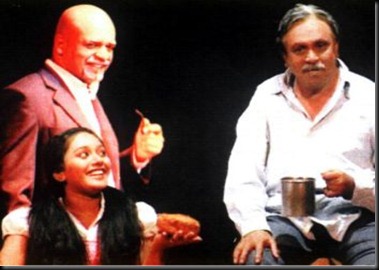
Oru Thengal is a short play is scripted by Soorya Krishnamoorthy and directed by Devan Nellimoodu.
Etho Chirakadiyochakal is written by Late G.Sankara Pillai with Kunthi as the central character; the story being narrated with a female perspective, where the episode with Karnna is introspected with compassion and reflecting the hidden pains of a helpless mother and her conflicts unravelled.
Bommanahalliyile Kinnara Yogi (Yogi with Kinnara at Bommanahalli– Chandradasan- Mazhavillu, Lokadharmi, Kochi - (16thOctober)
This play is enacted by Children of Mazhavillu- the children’s theatre group of Lokadharmi Kochi, written designed and directed by Chandradasan, based on the beautiful and imaginative adaptation of Browning’s Pied Piper, by the Kannada poet Kuvempu. 32 children perform in this musical spectacle with their energetic movements enjoying every moment on stage, singing, dancing, enacting with lot of fun, wit, satire, humour, histrionics and mischief.

The narrative of the play is straight, simple, and transparent that is relating to the hilarity and humor of the narration. The performance language is designed so as to give the space for creativity and the histrionic talent of the children, the whole process of rehearsal was exhilarating to the little actors; a scheme of rehearsal and play making that was more process oriented than the product, still resulting in a performance that was highly rewarding to all who participated, that includes the audience.
Vietnam Veedu –(Vietnam House)- Tamil- YG Mahendran – (17thOctober)

A stage play which was enacted by legendary actor Shivaji Ganesan has been revived by Y G Mahendran and the revival stays true to Sivaji Nataka Mandram’s original presentation. Y.Gee. Mahendran has retained the period of ‘Vietnam Veedu, and has retained the flavour of the original. Nowhere does he go overboard in his enthusiasm and anxiety.
Avanavan Kadamba (The self -Hurdle) – Kavalam– Sopanam, Thiruvananthapuram (18th October)
'Avanavan Kadamba, ' is a play conceived by Kavalam Narayana Panikkar, and directed by late G Aravindan, and was first enacted in 1976 with eternal relevance with contemporary echoes. He evolved a language, taking elements from the indigenous theatre of Kerala, both classical and folk. His use of songs, music and spectacle is exclusive to the aesthetics of Kerala. In theme, form, and audience participation, Avanavan Kadamba shows the distinctive stamp of Kavalam. In the process, the theme rises to the level of sheer poetry and reveals the folk wisdom that is unique to Indian philosophical thinking.
Avanavan Kadamba, a mile-stone production in the history of Malayalam theatre validates the contribution of regional theatre to the main stream Contemporary Indian theatre. Knitted in a loose narrative mode in real ethnic Malayalam with the rural flavour of the spoken word, the play communicates the magic realism of a forgotten horizon in its varied hues. The flexibility gives space to actors to interpret according to their sensibilities and perceptions.

This play enacted by veteran actors including Bharath Gopi, Nedumudi Venu, Jagannathan, Natarajan, etc, has been reproduced by younger actors of Sopanam with equal energy and appeal.
Makkalkoottam (The little class) – Pramod Payyannoor-Neeravil Prakash kalakendram, Kollam, (19th October)
Makkalkoottam, directed by Pramod Payyannoor is based on a novel by TV Kochubava, and presented by Prakash Kalakendram, Neeravil, Kollam, won the second best actor awards for Rajesh Sharma and Sreeranjini. This play looks into the untouchable community of low caste Chakkilayan, who have been marginalised into the outskirts of the society; victims of social custom, ignorance, and manipulated exploitation by the upper caste/class. The play uses a narrative style mixing up of traditional narrative of Theyyam, and Tholpavakoothu, along with realism. Innovative space design with good technical execution is another hall mark of the play.
Nritham(Dance) – M Vinod & N Binod – NatakaSauhridam, Trissoor(20th October)
 This year’s edition of Soorya Theatre Festival conclude with the play Nritham, based on the novel by M Mukundan directed by M Vinod and N Binod, which portrays the saga of a traditional Kalari exponent after he had been lured by the European market for contemporary dance and its alluring on traditional physical forms such as Kalarippayattu. The journey and the plight of the Kalari performer as a choreographer and dancer in the European and American art market, the cultural colonisation, and the sad return of the protagonist is delineated in this play in a simple direct narrative.
Bommanahalliyile Kinnara Yogi
In this beautiful and imaginative adaptation of Browning’s Pied Piper, Kuvempu retains almost all of the original imagery and structure; still the transformation into the Kannada cultural milieu is complete and authentic; the outlook and characteristics of the people and the narrative mode are completely localized to Kannada culture, perspective and expression.
 In Kuvempu poem is pungent with increased irony, pun, humor and have the weirdness of abstraction than the original. The structure of the performance text derived from this poem, naturally will be that of a poetic narrative, sung and enacted by a group of singer-actors. These singers might have traveled through ages and have witnessed/ inherited the poetry from ancestors. The singers join and attach themselves to the action as and when needed, and detach subsequently; they represent the people of the village. This continuous travel from character to singer-narrator and back will give an air of informality and provide a relaxed pursuit to the spectator.
The meaning and objective of this production is basically achieved through the rendering of the characters and their depiction. Each character is delineated and represented in specific exposé so that the narrative is developed into a form that relates to the contemporary reality and time.
Gowder is a usual, inefficient village-chief interested in nothing except collecting taxes, eating and sleeping. He has a big dog to scare people who complains; and is surrounded by a group of worthless intellectuals and advisers, unable to bring about solution to any problem. In a shift from the poem, the Gowda do not offer 6000 gold coins to Yogi, as reward to killing the rats. He offered this amount to any villager to keep his people silent from complaining, and was sure that none will come with any solution. One of the villager in turn told Jogi about this announcement. In fact the village does not have that much money in hand to spare, and Gowda was positioned in between an ‘yes’ and ‘no’ to Yogi.

The Kinnara Yogi character is particularly beguiling. Yogi is a performer and charmer who have immense ability to allure people. He boasts that he is the friend of lord Siva and Vishnu and has eradicated rats from Kailasa and Viakunta. And he insists that he shall get the money for his services. The space of the Yogi seems at the meeting point of the world meets with the legends, myths and fantasy; he has a link to mundane and with the imaginary. But he is alien to the rustic simplicity of the rural Bommanahalli and comes from a far away place with some odd objectives which the simpletons of the village cannot recognize. They are victims to the existing practice of the Gowda, the rat attack and later to the ploy of Yogi.
The rats are naughty and daring; they do all kinds of mischief, snatch the headgear of Gowda, and run a parallel government. They are represented with half masks, puppetry (glove, stick and hand) along with physicalisation and speak in a gibberish-rat language and/or also in Malayalam. In a metamorphosis the rats throw the headgears/masks/ and puppets to the river at the end of the play, and take the role of children.

The story of the pied piper is narrated direct and simple in this transparent and candid presentation; it is attempted to create a cosmos of the exuberance, earthiness, and hurdles of the rural life where various ecosystems co-exist. The people, Gowda and his men, artist/singers, Bhattas, cat, dog, rats, river and hills coexist to form a complete and balanced universe, mutually complimenting and completing.
Towards the end of the play the people understands the pain of the lone rat and decides not to kill it. The dog understands the reasoning of the people; the lament of the lame child who lost the heaven to be left in this unhappy world reverberates to the sensitivity of the people. It is the empathy with which men and animals understand and responds reciprocally that expresses the mutuality of existence subtly but clearly.
The play is basically designed for a proscenium, but extends beyond even to the outside of the theatre in the finale scene. The actors assemble around the installation of a Yogi effigy pronouncing that the story of Yogi happened many years before. As a tribute the Yogi story is performed every year and to end the performance they set fire to the Yogi effigy, as reminiscent in Ramleela and many other ritual performances.

The performance structure design and form is derived from many narrative forms from various living traditions. The first part is more hilarious, humorous, and slapstick; the entry of Yogi shifts into a musical narrative where the actors, sing, dance and perform the characters. Use of imaginative sets, properties and music suggest the space, characters, time, as well as the cultural/ political implications of the play.
The narrative of the play is straight, simple, and transparent that is relating to the hilarity and humor of the narration. The performance language is designed so as to give the space for creativity and the histrionic talent of the children, the whole process of rehearsal was exhilarating to the little actors; a scheme of rehearsal and play making that was more process oriented than the product.
The cast include Jeyabhami-Gowri Murali-Inkitha Inesh-Gouri Krishna, Varada, Sreenandini, K. N Meenakshi, K.Devasree Mohan, Unnimaya, Aishwariya.M., Amal, Unnimadhav, Jeya Sooriya M.A, Jayasuriya J, Arun A , Aravid Ajay, Sabareesh M.A, Ramakrishnan, Rithul, Rohin K , Diljaz, Nikhil Vishwam, , K.N. Dhruvakumar, Manutious, Alex.J.Puimood, Aravind.R, Aswathy A.S , Karthika.S, Kiran Xavier, Amar Mohan, Govind Nambiar, And Vijayakrishnan.

The Credits are; Anoop.S Kalarikkal (Art & Properties), Jolly Antony (Set), Kishore.M (Live Percussion), Reju Gregory( Harmonium, Key Board, & Guitar), -Aarsha Chandanavattam , &Nandini R Nair (Vocal Support), Shirly Somasundaram (Costumes), Rema.K Nair, (Make Up & Costume), Sarath R Nadh (Direction Assistance), Gireesh Menon (Music & Lighting) and Charu Narayanan (Stage In Charge). The Play Is Produced By Mazhavillu, the Children’s Theatre Of Lokadharmi, Scripted, Designed and Directed by Chandradasan.
Labels: Bommanahalliyile Kinnara Yogi, Chandradasan, children's Theatre, kuvempu, Lokadharmi, soorya festival, Soorya Hrishnamurthy


%5B3%5D.jpg "bommanahalliyile kinnara yogi swaralaya chandra (10)")
%5B3%5D.jpg "bommanahalliyile kinnara yogi swaralaya chandra (11)")
%5B3%5D.jpg "bommanahalliyile kinnara yogi swaralaya chandra (21)")
%5B3%5D.jpg "bommanahalliyile kinnara yogi swaralaya chandra (22)")
%5B3%5D.jpg "Bommanahalli jipson (25)")
%5B4%5D.jpg "Bommanahalli jipson (50)")
%5B5%5D.jpg "Bommanahalli jipson (18)")


%5B4%5D.jpg "Bommanahalli jipson (48)")
%5B4%5D.jpg "Bommanahalli jipson (9)")
%5B3%5D.jpg "Bommanahalli jipson (25)")
%5B3%5D.jpg "Bommanahalli jipson (41)")